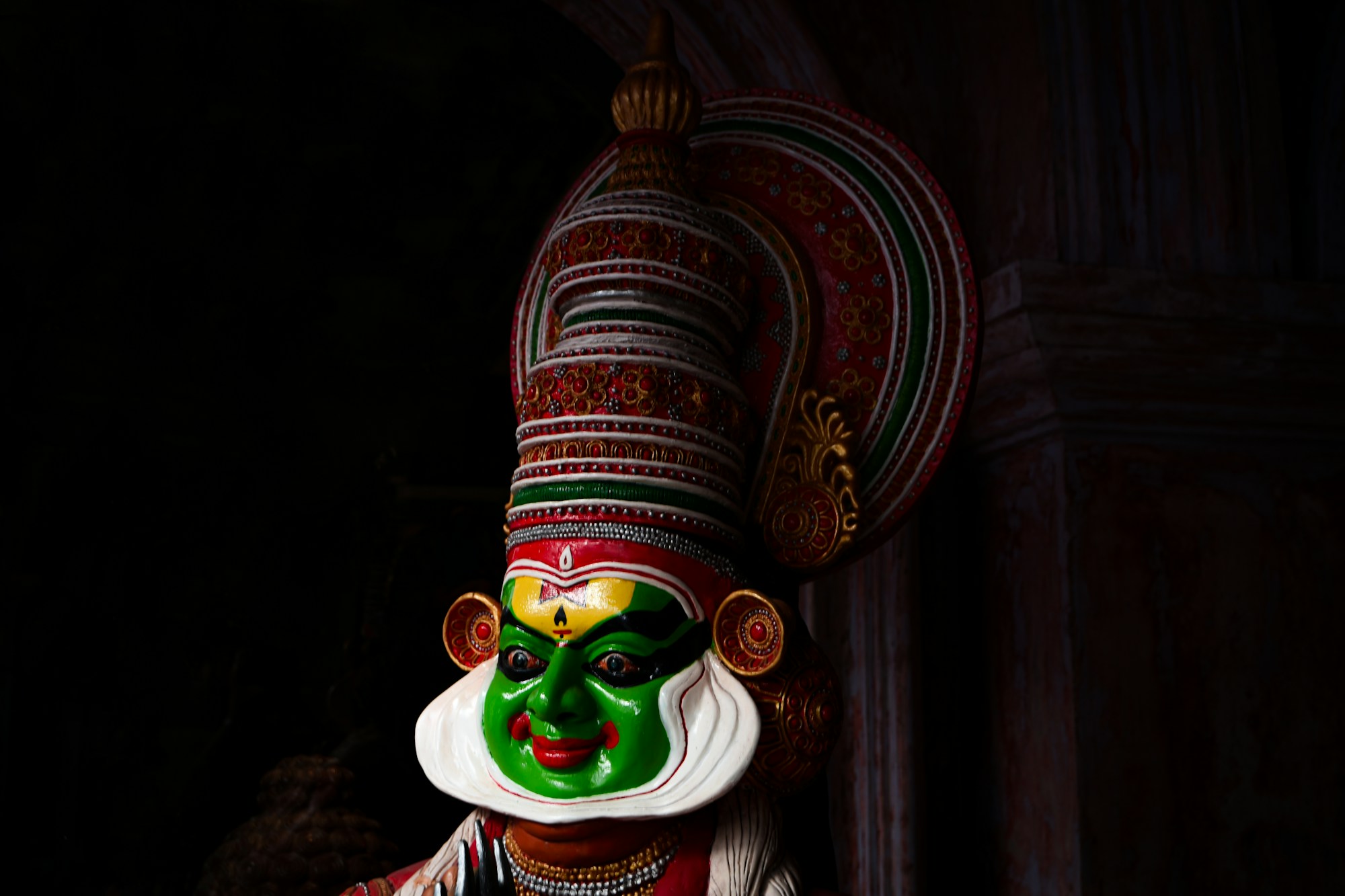
Kathakali✦KathakaliKerala's classical dance-theatre, in which elaborately painted and costumed performers enact the epics through codified gesture and expression. The…Read in the glossary ↗ compresses Kerala's temple epics into bodies: dancers trained from childhood perform the Mahabharata and Ramayana through codified expressions — nine rasas, twenty-four root gestures — under towering headdresses and face paint whose colours declare each character's nature. Green for the noble, red-streaked for the villainous, black for the demonic.
The connoisseur's secret is to arrive an hour early, for the make-up. Watching a seated dancer become a god — rice-paste ridges built along the jaw, eyes reddened with a seed placed under the lid — is a slow, hypnotic theatre of its own, and the key that unlocks the performance after.
How We Arrange It
- Green-room access for the full make-up ritual, with an interpreter of the art form beside you.
- Front-row seats at Fort Kochi's intimate theatres — the expressions are the performance; distance wastes them.
- For deeper interest: private recitals and kalari (training school) visits in the Kerala heartland.
When To Go
- Year-round in Kochi's cultural centres, nightly around 5–7 p.m.; temple festival season (Dec–Apr) adds all-night village performances.
Questions, Answered
What do the colours mean in Kathakali make-up?
The paint codes character: green (pacha) for noble heroes and gods, green with red marks (kathi) for arrogant villains, black for demonesses and hunters, yellow-white (minukku) for women and sages. The make-up itself takes two to four hours.
How long is a Kathakali performance in Kochi?
Tourist-centre performances run about an hour, preceded by an hour of public make-up and a demonstration of expressions — arrive for the make-up; it is half the experience. Traditional temple performances can run all night.
Journeys That Take You There

Explore the destination guide: Kochi, Kerala ↗