Culture, Craft & Cuisine6 min readPublished 12 June 2026
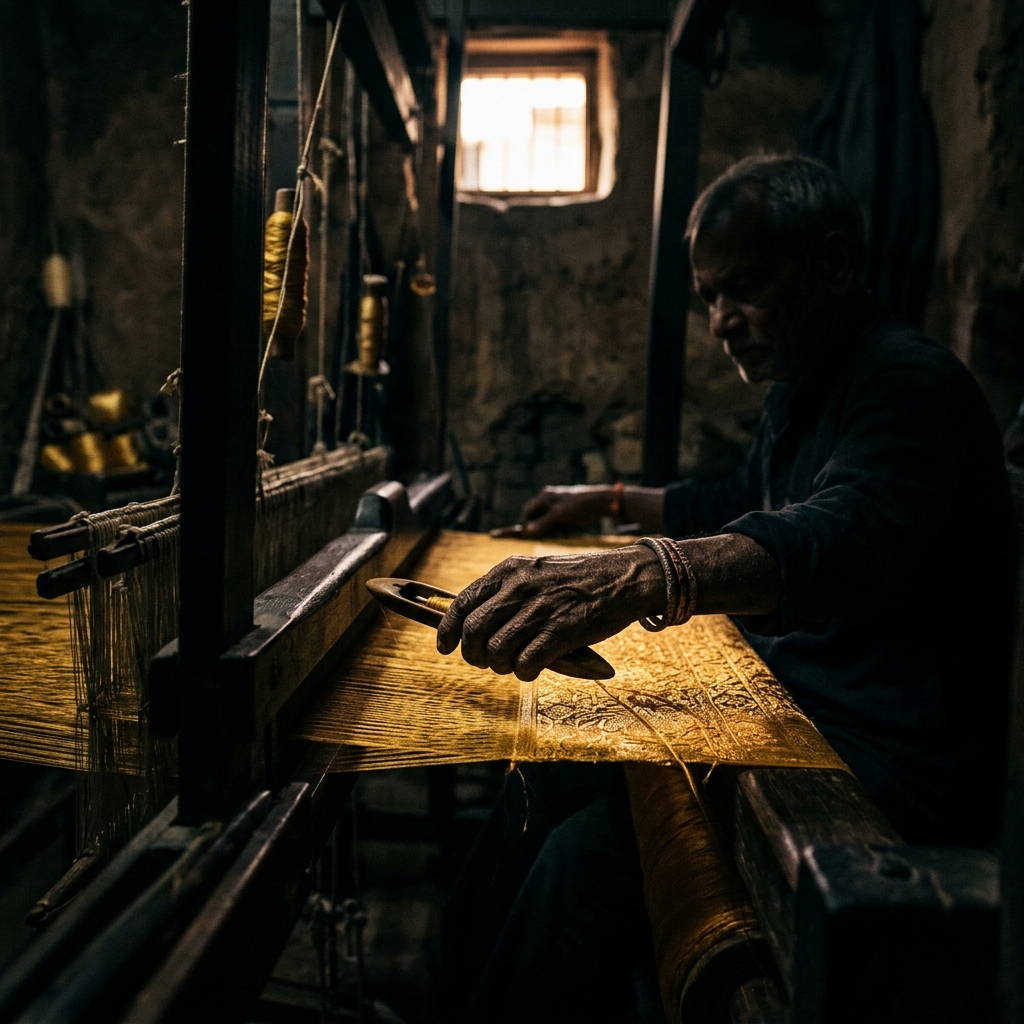
The sound reaches you before the sight does. Down a lane in Madanpura barely wide enough for two people to pass, a rhythmic wooden clatter comes through an open doorway — a pit loom, worked by a man whose father worked it, whose grandfather worked it, in a room where the pattern cards hang from the ceiling like laundry.
This is where Banarasi silk actually comes from. Not the emporia on the tourist circuit with their fixed smiles and 'government approved' signage, but small family workshops threaded through the Muslim weaving quarters of Varanasi, where perhaps forty thousand looms still run. The craft arrived with Mughal patronage in the sixteenth century and absorbed everything it touched: Persian floral motifs, Hindu temple borders, the intricate zari✦zariThread wrapped in fine silver or gold, woven into silk to make brocade — the glittering signature of Banarasi weaving, worked on jacquard pit looms…Read in the glossary ↗ work that uses thread wrapped in real silver and gold.
Why a single sari takes months
A fine Banarasi sari is not woven so much as constructed. The design is first drawn on graph paper, then punched onto cardboard jacquard cards — hundreds of them for a complex brocade — which the loom reads like a player piano. Two weavers work together on the richest pieces, one throwing the shuttle, one lifting the zari✦zariThread wrapped in fine silver or gold, woven into silk to make brocade — the glittering signature of Banarasi weaving, worked on jacquard pit looms…Read in the glossary ↗ threads by hand. On a good day they advance a few centimetres.
The result is fabric with the density of tapestry and the fall of water. Wedding families still travel from across India to commission pieces a year in advance, and the finest work never reaches a shop window at all — it moves by reputation, from master weaver to known client, the way it has for centuries.
Visiting the workshops properly
The weaving quarter does not perform for visitors, which is precisely its value. Arrive with the right introduction and you will drink tea while a gaddidar — the master of the house — unrolls work you will not see anywhere else, explains the difference between kadhua and cutwork brocade, and shows you why the reverse of a fine piece is nearly as clean as its face.
Elevated India arranges these visits through relationships built over years: a morning in two or three family workshops, time at the loom, and honest guidance on what a piece should cost — because the gap between tourist pricing and true value in Varanasi is wide, and knowing the difference is the whole game. Paired with dawn on the Ganges and the evening aarti✦aartiA Hindu ritual of worship in which lamps of flame are circled before a deity — or, at Varanasi and Pushkar, before the sacred river itself —…Read in the glossary ↗, the weaving quarter completes a Varanasi that most visitors never learn exists.
Questions, Answered
What makes Banarasi silk special?
Banarasi silk is hand-woven brocade from Varanasi, made on jacquard pit looms using silk yarn and zari (silver or gold-wrapped thread). Complex pieces involve two weavers working together and can take three to six months for a single sari.
Can visitors watch silk weaving in Varanasi?
Yes — but the authentic family workshops in quarters like Madanpura receive visitors by introduction rather than walk-in. Elevated India arranges private workshop visits with master weavers as part of its Varanasi journeys.
Journeys That Take You There